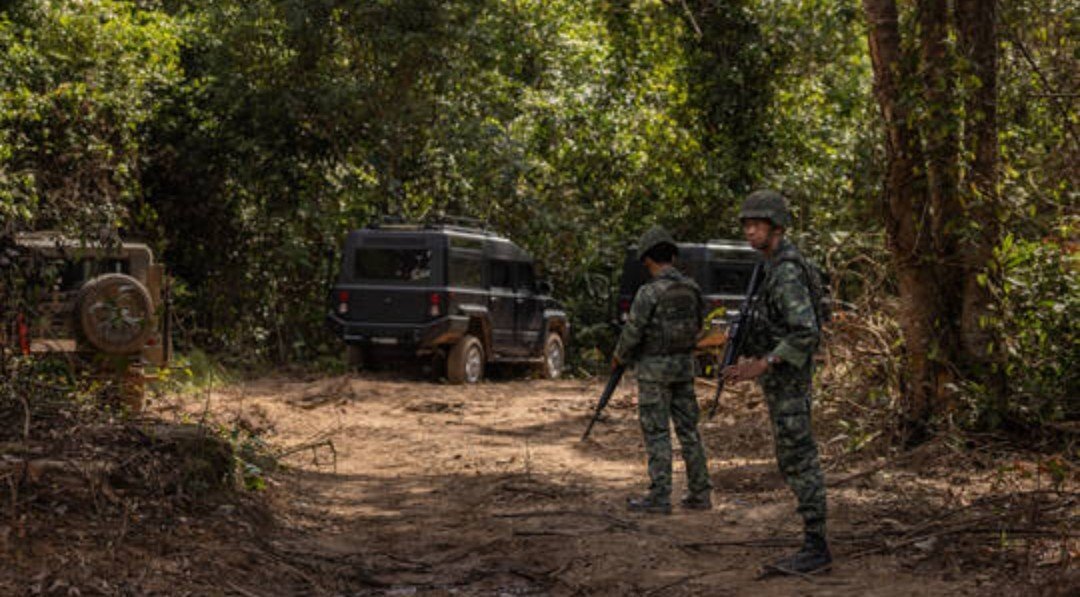
A fragile ceasefire is set to take effect along the disputed Thai-Cambodian border after a day of high-level diplomatic talks. However, comments from regional leaders quickly cast doubt on how long it will last. The truce was announced by U.S. President Donald Trump, who said he mediated talks between the prime ministers of the two countries.
The conflict focuses on a border area that has seen clashes for decades, despite a peace treaty signed in 1991. The latest and most intense fighting began this past Sunday, marking a significant increase in violence compared to earlier clashes in late July. Each government blames the other for starting the attacks, which have involved artillery and small arms fire in temples and villages near the border.
On Friday, Trump shared the news of the diplomatic breakthrough on his Truth Social platform. He wrote that he had a productive conversation that morning with Thailand’s Prime Minister Anutin Charnvirakul and Cambodia’s Prime Minister Hun Manet regarding the recent escalation of their long-standing conflict. Trump said both countries were ready for peace and that a ceasefire was agreed upon, starting Friday evening.
However, less than 24 hours later, the path to lasting peace seemed uncertain. Thai Prime Minister Anutin Charnvirakul posted a statement on social media Saturday morning that contradicted the ceasefire’s intent. He stated that Thailand would continue military actions until they felt no more threats to their land and people. While the statement did not outright reject the ceasefire, it suggested a defensive stance that could easily lead to renewed fighting, according to analysts.
The human cost of the recent fighting has been significant, based on official data from both governments. Thai Defense Ministry spokesperson Surasant Kongsiri confirmed nine Thai soldiers were killed and over 120 injured in the skirmishes. The Thai government also reported that nearly 200,000 civilians had to flee their homes in border provinces, seeking safety in temporary shelters further away.
The Cambodian Ministry of Interior offered even more alarming displacement figures on Friday, stating that over 300,000 Cambodian citizens had been evacuated from the conflict zone. Detailed casualty figures for Cambodian military personnel and civilians are not yet available, but earlier reports indicated deaths and injuries on both sides. Humanitarian organizations have raised concerns about the growing number of displaced individuals and the strain on resources needed for food, water and medical care.
The border dispute has deep historical roots, arising from boundaries established during the French colonial era. The most contentious area has been around the Preah Vihear temple, an 11th-century Hindu ruin that became a UNESCO World Heritage site under Cambodian administration in 2008. That designation led to a military standoff and sporadic fighting between 2008 and 2011. The International Court of Justice reaffirmed Cambodia’s sovereignty over the temple in 2013, but the surrounding territory remains disputed, with both nations maintaining nearby military outposts.
Regional security analysts note that U.S. involvement in mediating a ceasefire is unusual, as Southeast Asia typically relies on the Association of Southeast Asian Nations (ASEAN) or direct bilateral discussions. ASEAN, which includes both Thailand and Cambodia, has historically focused on consensus and non-interference but has sometimes struggled to respond quickly to crises among its member states.
The renewed violence and mass displacement present a significant challenge for both nations’ leaders. For Cambodian Prime Minister Hun Manet, who took office after his long-ruling father last year, this conflict serves as a major test for his administration's capability in managing a national security crisis. For Thai Prime Minister Anutin Charnvirakul, who leads a coalition government, the need to show strength in defending Thai territory is weighed against the economic and humanitarian costs of an extended conflict.
International reactions have been cautious but concerned. A United Nations spokesperson stated that the organization is closely monitoring the situation and urged maximum restraint and a return to negotiations. Officials from neighboring Vietnam have offered to help facilitate talks, while major powers with regional interests, including China and the United States through diplomatic channels, have called for de-escalation. As the ceasefire holds, the immediate focus will be on the ground situation. Military observers will watch for troop movements or supplies that might indicate preparations for renewed violence. Aid agencies are trying to coordinate cross-border relief for displaced populations, although access remains tricky due to ongoing security concerns and logistical issues.
The next few days will show if the announced ceasefire leads to meaningful negotiations or just serves as a brief break in a longer, more destructive conflict. The mixed signals from the region’s capitals indicate that, without sustained international involvement and a genuine commitment to diplomatic resolution from both governments, the stability of the border area remains at serious risk.