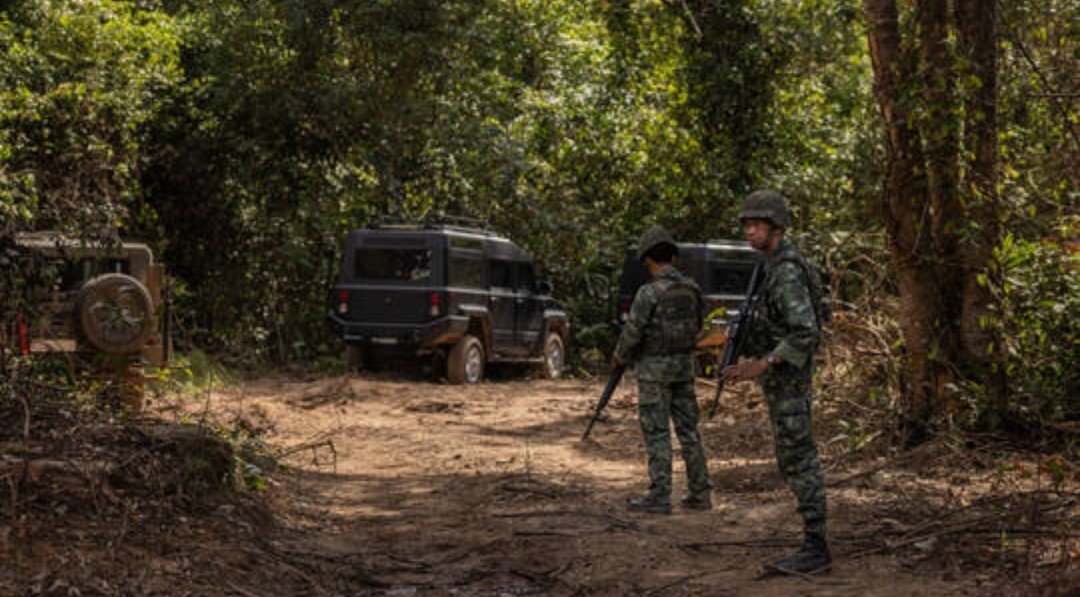
A US-brokered ceasefire between Thailand and Cambodia, was shattered on Monday after the Royal Thai Air Force launched strikes inside Cambodia. This marked a serious escalation in a long-standing border dispute. The new violence began over the weekend, leading to mutual accusations of aggression and dimming hopes for a diplomatic solution tied to colonial history.
The latest cycle of violence started on Sunday, according to the Royal Thai Army. Thai military officials claimed Cambodian troops began the fighting by firing on Thai soldiers stationed in Ubon Ratchathani. The Thai account stated that one soldier was killed and four were injured in the engagement. They also alleged that later attacks using artillery and unmanned drones targeted the Thai Anupong Base.
In a major escalation, the Royal Thai Air Force confirmed on Monday that it deployed F-16 fighter jets for missions across the border. Air Force spokesman Air Marshal Jackkrit Thammavichai described the operation as necessary for national security and civilian safety. This use of air power marks a significant shift from the ground skirmishes that have characterized the dispute for years.
Cambodia’s Defense Ministry has strongly denied the Thai version of events. Ministry spokeswoman Lieutenant General Maly Socheata provided a different account late Sunday. She claimed it was Thai troops who launched an attack on Cambodian positions, using small arms, mortars, and tanks. Socheata insisted that Cambodian forces showed restraint and did not retaliate. She also called Thai claims of a Cambodian military buildup along the border “baseless” provocations.
The root of this lengthy and violent conflict lies in the legacy of European imperialism, not modern politics. The current border issue stems from ambiguities in the boundary demarcations and maps created during French colonial rule over Cambodia, which ended in 1953. The often imprecise colonial maps lead to conflicting interpretations, especially regarding the sovereignty of the Preah Vihear temple complex which became a focal point of the dispute. The temple itself was awarded to Cambodia by the International Court of Justice in 1962, citing historical maps and French survey documents but the surrounding territory remains hotly disputed as the court did not delineate the surrounding territory, leaving the adjacent highlands, cliffs and approaches to the temple in a state of legal and military uncertainty.
This geographical uncertainty erupted into open warfare earlier this year. In July, intense fighting involving heavy artillery and rockets resulted in dozens of soldiers and civilians killed from both nations. The violence caused a major humanitarian crisis, displacing over 200,000 residents from border villages. They were forced to flee their homes amid the shelling. The scale of the displacement and the use of indiscriminate artillery in populated areas drew international concern. A temporary truce was only achieved after diplomatic efforts by the United States, but it now seems to have collapsed.
The return to violence, marked by cross-border airstrikes, raises urgent questions about failed diplomatic efforts and the high human cost of renewed conflict. Observers note that this escalation benefits hardline nationalist factions within both countries, potentially compromising civilian safety and regional stability. The use of airstrikes, even if limited, significantly increases the risk of miscalculation and further war, while putting communities at risk that are still healing from the summer’s violence.
Critics of the Thai military actions argue that these operations harm peaceful conflict resolution efforts and breach international standards. They stress that a century-old border dispute cannot be solved through airstrikes but requires ongoing, good faith engagement in international arbitration and bilateral dialogue. The repeated failures of ceasefires highlight the limits of temporary truces and the urgent need for a permanent, fair settlement mediated by neutral international organizations.
The international community, especially the Association of Southeast Asian Nations (ASEAN), now faces new pressure to take action. ASEAN’s principle of non-interference has typically constrained its ability to mediate between member states, but the rising military tensions between Thailand and Cambodia challenge the bloc’s credibility and commitment to regional peace. The United Nations Security Council may need to readdress the situation if hostilities escalate.
As tensions stay high, the international community has encouraged dialogue as a means of resolving the conflict. The recent escalation points to the ongoing challenges in resolving this long-standing territorial dispute through diplomacy alone, without a solid and fair political settlement based on justice instead of military might. The immediate focus must be on enforcing the ceasefire and protecting civilians in the affected border areas. A lasting resolution will require ongoing engagement from both parties and continued international support for a negotiated settlement.