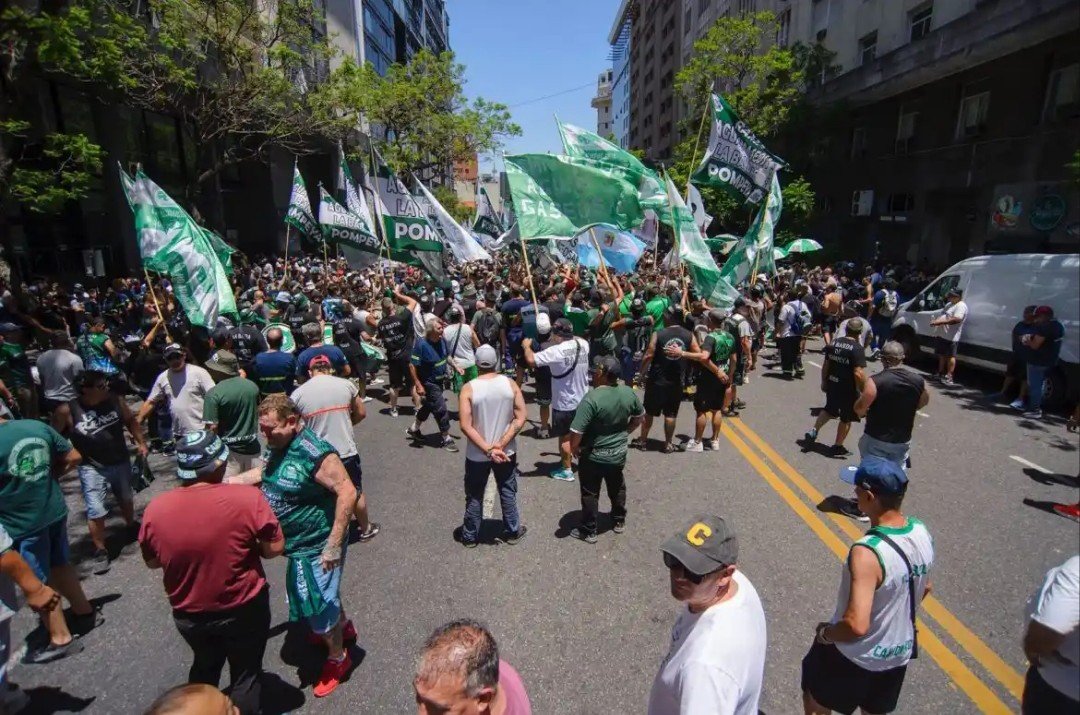
Tens of thousands of workers filled the historic Plaza de Mayo on Thursday to protest a large labour reform package proposed by President Javier Milei’s government. The demonstration, led by the General Confederation of Labour (CGT), represented a strong pushback against a legislative agenda that critics say favours corporate interests over the basic rights of Argentine workers.
The protest paralysed the downtown area of the capital and was echoed by similar events in cities across the country. This marks a significant rise in tensions between the libertarian government and a wide coalition of labour unions and social groups. These organisations stand together against what they see as a backward overhaul of the nation’s labour laws.
Union leaders used the demonstration to send a clear warning to the government about the future of industrial relations in Argentina. Octavio Argüello, a co-general secretary of the CGT, addressed the crowd and said that their current struggle is just beginning. He stressed that if the government continues to ignore workers’ concerns, the movement will escalate, potentially leading to a nationwide strike.
The proposed legislation, called the Labour Modernisation Law, has sparked significant social tension. While the Milei administration claims the bill is necessary to cut bureaucratic red tape and promote formal job creation, labour advocates argue that the reality is quite different. Cristian Jerónimo, a CGT leader, stated that the bill does not provide real solutions to the challenges faced by workers. He described it as leaning toward large corporations in a regressive manner.
Jerónimo also pointed out that the proposed changes do not offer any benefits for small and medium-sized companies (SMEs). He argued that the legislation fails to create real job opportunities and instead deepens an economic model that marginalises vulnerable groups, especially women and young people.
The specifics of the reform have attracted sharp criticism. If it passes, the law would give employers much more freedom to manage working hours and employee vacations. It introduces a controversial working hours bank system and seeks to change the existing severance pay rules. The goal of these changes is to lower costs for companies, but unions argue this is at the direct expense of worker security.
Additionally, the bill includes new restrictions on the right to strike. Under the proposed rules, a broader range of labour sectors would be labelled essential, meaning they would need to maintain a certain level of operations during strikes. The legislation also requires unions to get employers’ permission before holding meetings at work, which labour leaders see as an attack on their independence.
Jorge Sola, another co-general secretary of the CGT, framed the protest as a defence of human dignity. He said that workers do not want fewer rights; they want more work and more respect. Sola also painted a bleak picture of the economy, saying the country’s social fabric has been unravelling for two years. He shared statistics showing that one business closes every hour and that hundreds of workers lose their jobs each month, providing a troubling backdrop for the legislative discussion.
The CGT’s executive council, including representatives from key sectors like trucking, construction and healthcare, officially supported the mobilisation. The oilseed workers’ sector also joined the protest this week, calling for a 24-hour strike specifically against the labour reform.
Politically, the protest has gained support from the centre-left Peronist opposition. Axel Kicillof, the Governor of Buenos Aires Province, expressed alignment with the labour movement. Kicillof criticised the bill for not including anything that would benefit workers. He also noted that the legislation lacks support from the struggling SME sector, which is a crucial part of the local economy.
Due to this widespread criticism and the scale of the street protests, the government has been compelled to change its legislative timeline. Senate hearings have delayed the debate on the reform. The administration had originally sought preliminary approval by next week. However, Patricia Bullrich, chair of the Senate Labour Commission, announced a new debate date of February 10.
Bullrich said the commission would sign a draught version of the bill that remains open to future changes. She explained this choice was in response to requests from various sectors wanting to further discuss the law instead of debating it on the previously scheduled date of December 26. While Bullrich argued that signing a draught version offers some certainty, the final text of the legislation has not yet been disclosed.
This lack of clarity and the perceived rush of the process have drawn criticism from lawmakers. Senator Mariano Recalde remarked that while it is good the debate is extended instead of rushed, he expressed disappointment with the draught version. Recalde noted that the current version does not include feedback or proposals from the opposition, including ideas previously deemed acceptable by the government.
With the labour debate postponed, immediate legislative attention has shifted to fiscal issues. December 26 will now focus on voting on the 2026 budget and a separate fiscal bill. The government is under pressure to secure a commission-approved version of the 2026 Budget bill by Friday, December 19.
The administration is facing a tight deadline to pass the budget through the Senate within the last five business days of the year. This urgency comes after the original proposal stalled in the lower house. If the government does not pass the new budget by the end of the year, it risks extending the 2023 budget for a third straight year, complicating its economic strategy and fiscal goals.
The current political environment in Congress reflects the results of the October midterm elections. President Milei’s party, La Libertad Avanza, gained significant ground, becoming the largest minority in the lower house and expanding its presence in the Senate. Even with this increased representation, the administration still needs wider support to pass its bold reform agenda, which Milei argues is essential for boosting the national economy.
The labour reform stands as a central piece of this agenda, but it remains the most contentious issue. The large turnout in Plaza de Mayo and other cities indicates that the government’s plans to relax labour regulations will meet ongoing resistance. The unions have made it clear their opposition is not just about specific aspects of the bill, but about the overall direction of the country’s economic and social policies.
The mobilisation by the CGT and its allies showcases a broad coalition of interests. From healthcare workers to construction crews and truck drivers, the protest illustrates that many are worried the proposed changes will harm the quality of life for average Argentine workers. The involvement of social movements in the protest also highlights growing concerns about the implications of these policies on the larger social fabric.
As the country approaches the end of the year, the focus remains on Congress and the streets. The government’s decision to postpone the labor debate until February offers a brief pause, but the core disagreements still need resolution. The unions view the Labour Modernisation Law as a threat to the rights they have worked hard to achieve and seem ready to maintain their pressure through the summer.
The upcoming struggles over the budget and fiscal bill in late December will set the stage for renewed discussions on labour rights in February. For the Milei administration, the challenge remains to navigate a Congress where it has gained strength but still lacks a majority, while facing a well-organised labour movement that can bring the capital to a standstill.
The next few months will reveal if the government can realise its vision for a deregulated economy or if the pressure from unions and the political opposition will force it to back down from its current proposals. For now, the images from a packed Plaza de Mayo serve as a stark reminder of the strong resistance to a policy framework many Argentines believe puts corporate profit ahead of people’s well-being.