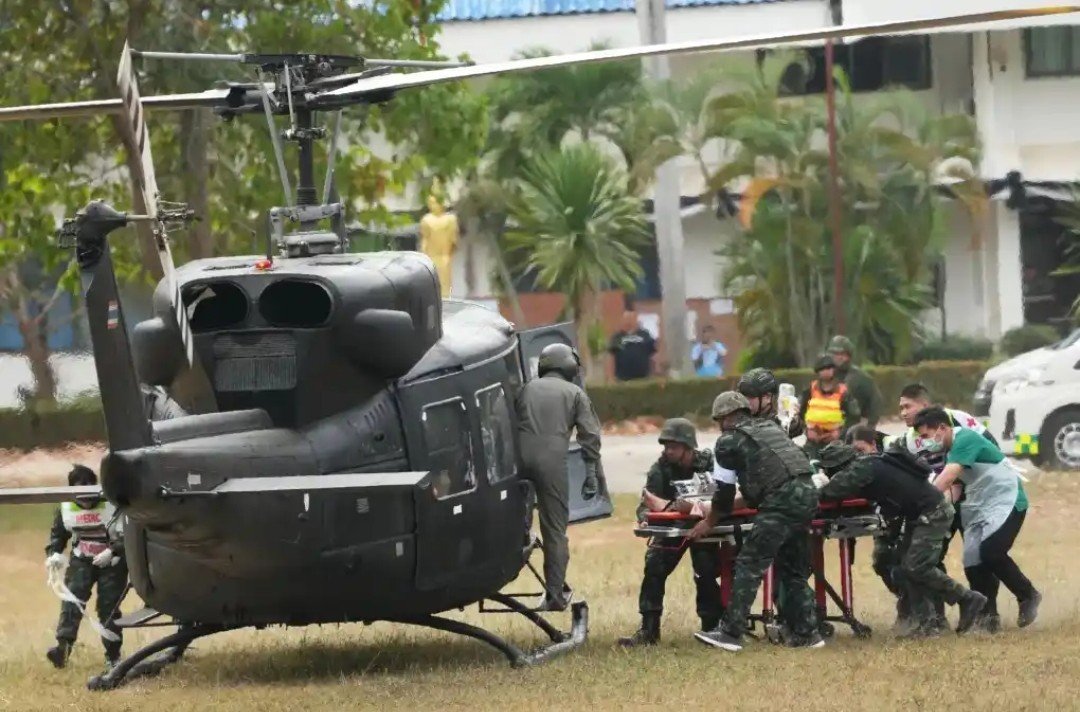
Thailand and Cambodia engaged in renewed cross-border artillery exchanges on Saturday, with both governments reporting strikes hitting civilian areas. This escalation occurred just one day after U.S. President Donald Trump claimed that the leaders of both nations had agreed to a renewed truce. The hostilities have worsened a humanitarian crisis in Southeast Asia and civilian areas have become targets of military aggression, once again.
This recent escalation contradicts Trump’s statements made on Friday, when he announced on his Truth Social platform that both nations had reached a formal agreement to end the week-long conflict. Thai officials quickly refuted this claim, stating that the situation on the ground is worsening rather than moving toward peace.
The Thai Ministry of Foreign Affairs clarified in a statement on Saturday morning that no truce currently exists. The ministry noted that while diplomatic channels remain open, conditions for a ceasefire have not been met due to ongoing incursions.
Defense Ministry spokesperson Surasant Kongsiri confirmed that active combat continued through the night and early morning. Kongsiri stated that Thai forces remained in a defensive position but were responding proportionally to Cambodian provocations.
The gap between the optimistic assessment from the White House and the ongoing violence has raised concerns among international observers about the effectiveness of U.S. intervention in the region. Critics argue that the rush to declare a diplomatic victory may have undermined delicate local negotiations facilitated by the Association of Southeast Asian Nations, or ASEAN.
Prime Minister Anutin Charnvirakul spoke to local media in Bangkok, stressing that his government will not prioritize appearances over national security. He stated that reports of a ceasefire mischaracterized preliminary talks. The Thai military will continue its operations as long as civilian safety remains at risk.
The human cost of the conflict reached a grim milestone this week, with at least 20 confirmed deaths since the fighting began. On Saturday, the Thai military reported on the social media platform X that Cambodian forces fired rockets into residential areas in Sisaket province.
The strikes in Sisaket injured at least four individuals, including two elderly residents unable to reach underground bunkers in time. Local health officials reported injuries ranging from shrapnel wounds to severe respiratory distress caused by smoke and debris from destroyed structures.
For thousands of villagers living along the disputed border, the week has been marked by fear and displacement. Temporary shelters in schools and community centers are overflowing, and many families lack access to clean water and medical supplies. Humanitarian organizations worry that the continued shelling may violate international humanitarian law and are calling for an immediate opening of aid corridors.
On the Cambodian side of the border, the Defense Ministry used Facebook to share its version of events. In a post on Saturday, Cambodian officials claimed that Thailand had been conducting a sustained bombing campaign against Cambodian territory. These assertions, including reports of aerial strikes on rural villages, could not be independently verified by international press agencies or neutral observers.
The current violence is part of a long-standing territorial dispute centered on the ancient Preah Vihear temple and surrounding land. While the International Court of Justice reaffirmed its 1962 ruling in 2013, nationalist sentiments in both countries have often been used by political leaders to rally domestic support, jeopardizing regional stability.
Political analysts say that the current conflict is aggravated by rising economic inequality and social unrest within both nations. By framing the border dispute as a matter of national sovereignty, both governments may be trying to distract the public from internal challenges.
Left-leaning advocacy groups in the region have condemned the military posturing of both governments. They argue that working-class people on both sides are being used as pawns in a geopolitical game serving only the interests of military elites and nationalist politicians.
“The people of Sisaket and Preah Vihear share more in common with each other than with the generals in Bangkok or Phnom Penh,” said a representative from a regional human rights coalition, who spoke anonymously for fear of government retaliation. “This is a war of choice that is being paid for with the lives of the poor.”
The international community has struggled to respond to the crisis. While Trump’s administration has tried to position itself as the chief mediator, the African Union and various European Union representatives have called for a more collaborative approach involving the United Nations.
United Nations Secretary-General António Guterres released a statement on Saturday afternoon urging both sides to show restraint. He emphasized the need to return to the 2013 roadmap established by the International Court of Justice and warned that ongoing military escalation could destabilize the broader Mekong region.
The role of ASEAN has also faced scrutiny. The regional bloc, guided by a principle of non-interference, has been slow to organize a peacekeeping or fact-finding mission. However, several member states, including Indonesia and Malaysia, have offered to host neutral talks if Thailand and Cambodia agree to a temporary halt of hostilities.
Beyond immediate casualties, the conflict significantly harms the local environment and regional economy. The border area contains protected forests and diverse wildlife populations that have been devastated by heavy artillery and incendiary munitions.
Cross-border trade, vital for many small-scale farmers and merchants, has halted completely. The closure of key checkpoints has caused food prices to soar in border towns, further straining the resources of families already struggling.
Economists warn that a prolonged conflict could discourage foreign investment in Southeast Asia, especially as the global economy faces challenges. This instability in the Thai-Cambodian corridor is particularly troubling for the tourism industry, which had just begun to recover.
As night fell on Saturday, reports of sporadic gunfire and distant explosions continued from the border area. The truce announced by the White House seems to have had no effect on military actions by either side. The Thai military has strengthened its positions with additional armored units, indicating that a withdrawal is not imminent. Meanwhile, Cambodian officials have maintained defiant rhetoric, asserting their right to defend what they see as ancestral lands.
For residents of Sisaket and neighboring provinces, the night brings a frightening possibility of further displacement. Families huddle in makeshift bunkers and listen for incoming rockets, while the diplomatic world remains divided on bridging the gap between words and actions.
The lack of independent verification of both defense ministries’ claims complicates efforts by journalists and aid workers to assess the true extent of devastation. Without a neutral monitoring presence, the conflict remains a battle of narratives, with civilians caught in the crossfire of competing nationalisms and failed international diplomacy.
The Thai Ministry of Foreign Affairs plans to hold a briefing on Sunday to outline its conditions for a genuine peace process. Whether Cambodia will agree to those conditions or if the U.S. administration will seek further intervention remains unclear.