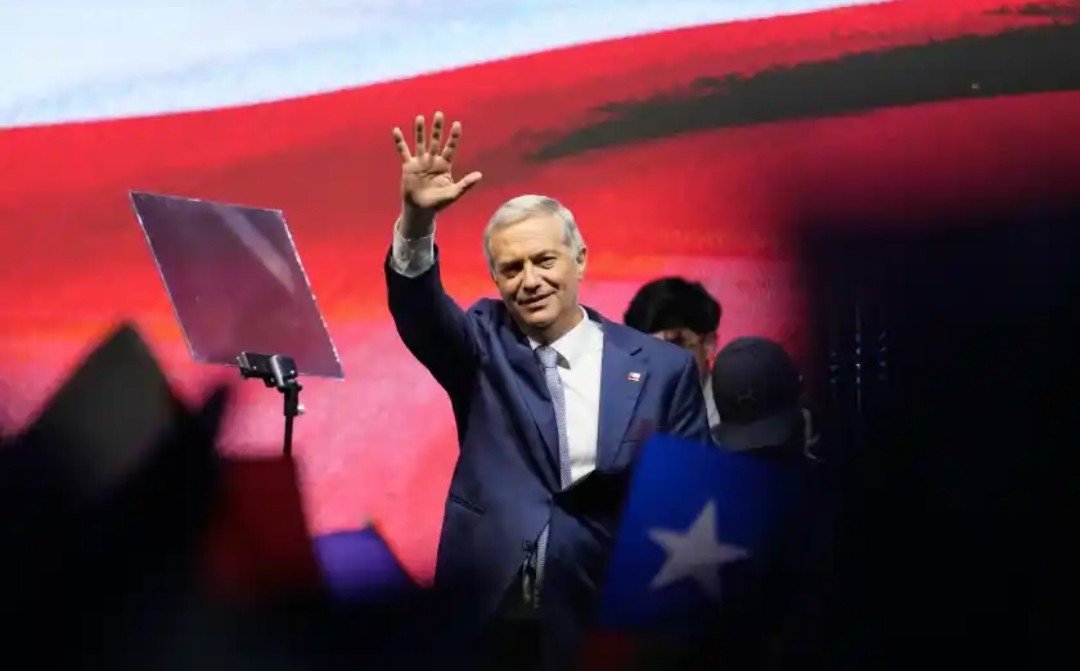
In a stunning turn of events in Latin America, far-right leader José Antonio Kast won a decisive victory in Chile’s presidential runoff on Sunday. This win represents a significant ideological shift for a nation that just four years ago was seen as a leader of the region’s progressive “pink tide.”
According to the final results from Chile’s Servel electoral authority, Kast, the head of the Republican Party, received 58% of the vote. His opponent, former Labour Minister Jeannette Jara, came in second with 42%. Jara, a Communist Party member who focused on expanding the social safety net and continuing the reforms of outgoing President Gabriel Boric, could not maintain the momentum that had her finish first in the initial voting round.
This change is more than just a new leader. It signals a rise of hardline conservative views in a country still dealing with the consequences of its authoritarian past. Kast, a lawyer and former congressman, has often defended the military dictatorship of Gen. Augusto Pinochet, whose rule from 1973 to 1990 was marked by severe human rights abuses, disappearances and the dismantling of democratic institutions.
Kast is set to be inaugurated in March. Under Chile’s constitution, he will serve a four-year term that ends in 2030, taking over from Boric, who cannot seek immediate reelection due to legal restrictions.
A Narrowed Path to Victory
The runoff results showed a strong consolidation of the Chilean right. Although Jara started the second round with a slight advantage, she faced a divided political landscape. Kast, who finished second in the general election, successfully united conservative and ultra-conservative voters who had previously spread their support among three right-wing candidates.
Political analysts believe that worries about public safety, irregular migration and a lagging economy pushed moderate voters toward Kast’s “law and order” platform. Throughout the campaign, Kast emphasized border security and the protection of private property, themes that resonated with voters in the northern and southern regions of the country.
“Thank you, Chile. Let’s get to work!” Kast posted on the social media platform X late Sunday, as his supporters gathered in the affluent neighborhoods of Santiago to celebrate.
In a televised address from the Moneda presidential palace, President Boric confirmed he had spoken with the president-elect to work on a transition. Boric, whose administration struggled with low approval ratings despite passing landmark labour reforms, offered a tone of institutional respect. He invited Kast to a formal meeting on Monday to begin the handover process.
Jara also conceded on Sunday evening. “Democracy spoke loud and clear,” she wrote on X. She stressed that while the results were disappointing for the left, the fight for social justice in Chile would continue as an organized opposition.
Kast’s rise is especially significant given his personal and political background. He is the son of Michael Martin Kast, a German military officer who served in the Nazi army during World War II before moving to Chile in 1947. While Kast has often tried to separate his political career from his father’s past, his opponents highlight his family history and his own praise for the Pinochet era as proof of an extremist viewpoint.
Kast, a 57-year-old former congressman, has run for president twice before, losing narrowly to Boric in the 2021 runoff. His political agenda focuses on a tough stance on crime and immigration, pledges to reverse recent tax hikes and aims to privatize state assets.
This win also marks a major success for the Republican Party, which Kast founded after leaving the traditional center-right Independent Democratic Union. The party’s rise parallels the growth of far-right movements in Europe and North America, emphasizing nationalist identity and a rejection of what Kast calls “progressive globalism.”
International Reaction
The global response to the election was quick, showing the widening ideological divide in the Americas. The victory was celebrated most enthusiastically by prominent right-wing figures in the region, many of whom view Kast as an important ally in the ongoing conflict against leftist governments.
Argentine President Javier Milei expressed “great joy” over the results. Milei, a libertarian known for his radical “chainsaw” policy of austerity in Argentina, claimed that Kast’s win pushes the region toward the “defense of life, freedom, and private property.”
Milei posted a color-coded map of South America by political affiliation on social media, captioning it, “The left backtracks, freedom advances.” He expressed eagerness to work with Kast to help the Americas “free ourselves from the 21st-century socialist yoke.”
In Brazil, the victory was praised by the family of former President Jair Bolsonaro. Eduardo Bolsonaro, a national deputy and son of the former leader, noted that “the right wins in Chile” and used the moment to promote his brother Flavio’s future political ambitions. The Bolsonaro family has long viewed Chile as a testing ground for the neoliberal and social conservative policies they hope to implement in Brasília.
Despite the ideological differences, several leftist leaders in the region maintained diplomatic decorum. Brazilian President Luiz Inácio Lula da Silva and Mexican President Claudia Sheinbaum both issued statements wishing Kast success and showing a desire for stable bilateral relations. However, analysts expect a slowdown in regional integration efforts, as Kast has openly criticized organizations like Mercosur and CELAC.
Venezuelan opposition leader María Corina Machado also weighed in, hoping that a Kast administration would “take a tougher stance” against Nicolás Maduro’s government. She expressed anticipation for Kast’s support in an “orderly transition toward democracy” in Caracas.
Kast’s victory also resonated in Europe, where far-right and national-conservative parties have gained support recently.
In Spain, Santiago Abascal, the leader of the Vox party, congratulated Chile for selecting what he called “truth, freedom and prosperity.” Abascal has collaborated closely with Kast in recent years through the “Madrid Charter,” an agreement among right-wing leaders aimed at combating leftist influence in the Iberosphere.
Italian Prime Minister Giorgia Meloni, who aims to connect traditional conservatives with the far right, shared a photo with Kast. She expressed optimism that bilateral relations would strengthen, particularly regarding economic cooperation and managing illegal immigration.
In the United States, reactions reflected the current political climate in Washington. U.S. Secretary of State Marco Rubio congratulated Kast on behalf of the administration. Rubio, a proponent of a stronger U.S. policy in Latin America, said he was confident that both nations would advance shared priorities such as public safety and trade.
President Donald Trump did not give a formal public comment on Sunday, but his previous statements have often echoed the nationalist themes Kast promoted during his campaign.
While Kast’s mandate appears strong based on a 16-point margin of victory, he faces a deeply divided country. The Chilean Congress remains split and many social issues that sparked the 2019 mass protests—inequality, high living costs and an aging pension system—are still unresolved.
Jara’s supporters and labor unions have already indicated that they will oppose efforts to reduce environmental protections and labor rights. The transition period between now and March is expected to involve intense negotiations as the new administration tries to build a governing majority.
For now, this victory serves as a significant moment for the global right. By shifting a key South American economy from a progressive administration to a far-right one, Kast has offered a blueprint for conservative movements aiming to regain power through a mix of traditional cultural values and strict security policies.