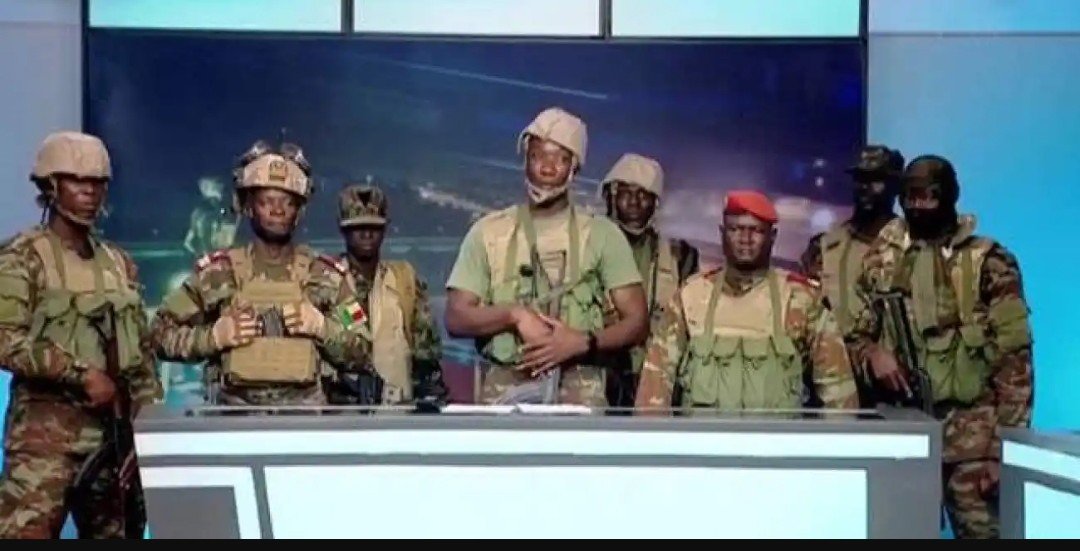
Benin’s military officials have announced the arrest of about a dozen soldiers linked to an attempted coup that took place on Sunday. Official statements confirm that thirteen individuals are in custody, including those believed to be the leaders of the operation.
Most of the detained suspects are active-duty military members, with one reported to be a former soldier. The arrests came after a brief takeover of the state broadcaster, Office de Radiodiffusion et Télévision du Bénin (ORTB), on Sunday morning.
During the broadcast, a group of military officers appeared on national television, calling themselves the “Military Committee for Refoundation.” They declared the dismissal of President Patrice Talon, dissolved the government and all state institutions and claimed to have taken control of the country.
Government loyalists quickly contained the situation. The presidency assured the public that President Talon was safe and that constitutional order was being restored. In a statement, the government downplayed the severity of the event, describing it as a limited faction with little support within the broader security forces.
“This is a small group of people who only control the television. The regular army is regaining control. The city and the country are completely secure,” a presidential spokesperson said.
This incident adds Benin to a growing list of West African countries that have experienced military rebellions or successful takeovers recently. Since 2020, coups have occurred in Mali, Guinea, Burkina Faso and Niger. There have also been reported coup attempts or political instability in Guinea-Bissau, Sudan and Madagascar, indicating a regional trend of political unrest.
The international reaction to the events in Benin has been quick. The African Union (AU) strongly condemned the attempted takeover. In a statement, AU Chairperson Moussa Faki Mahamat called the actions a direct attack on Benin’s democratic system and constitutional legitimacy. He reaffirmed the AU’s principle of “zero tolerance” for unconstitutional changes of government.
The Economic Community of West African States (ECOWAS) also condemned the attempt. The regional organization announced its decision to deploy its standby force. ECOWAS characterized the failed coup as a “subversion of the will of the people of Benin” and promised to support the Government and the people of Benin in any necessary way, including military action to defend the constitution and the country’s sovereignty. This position aligns with ECOWAS's recent efforts, though often challenged, to prevent military interventions in West African politics.
The coup attempt occurs amid complex geopolitical sentiments in the region. While not as openly discussed in Benin as in some neighboring Sahel countries, there is a noticeable undercurrent of public discussion about France’s historical and contemporary role in West Africa. This sentiment is often grouped under criticism of “Françafrique” or neocolonial influence, which has been growing stronger in recent years.
The conversation centers on perceptions of ongoing French economic dominance, military presence, and political influence in its former colonies. In countries like Mali, Burkina Faso and Niger, military juntas have cited this frustration as partial justification for their takeovers, along with calls for the withdrawal of French troops and changes in international partnerships. Although Benin has kept a relatively stable and friendly relationship with France, it is not completely immune to these regional trends. Some critics in the country occasionally highlight French economic interests in Benin’s crucial cotton and port sectors as points of contention.
President Patrice Talon, a former cotton trader first elected in 2016 and reelected in 2021, has pursued an agenda focused on economic modernization and has been a key ally in regional counterterrorism efforts. However, his government faces criticism from some opposition groups and civil society organizations. They have raised concerns about accusations of democratic backsliding, including prosecuting opposition leaders and altering electoral laws that limit political competition. These domestic tensions, common in many democracies, are seen by analysts as potential openings for those who want to seize power unconstitutionally.
The immediate cause and full motivations behind Sunday’s attempt are still under investigation. The quick collapse of the plot indicates it lacked widespread support within the Beninese military command. Security has been tightened in the administrative capital, Porto-Novo and the economic capital, Cotonou.
The government has stated that legal actions will follow the arrests. The outcomes of these proceedings will be watched as indicators of the state’s commitment to judicial norms in a post-crisis context. The attempted coup, though unsuccessful, serves as a strong reminder of the challenges facing democratic governance in West Africa. It highlights the difficulties posed by internal political strife, the spread of regional instability and a changing geopolitical landscape where traditional partnerships are being questioned. The strong response from ECOWAS and the AU will be tested as they balance respect for sovereignty with their commitment to constitutional order. For Benin, a country previously known for its political stability, this event calls for a period of reflection to address any underlying issues that may have allowed for such an action.