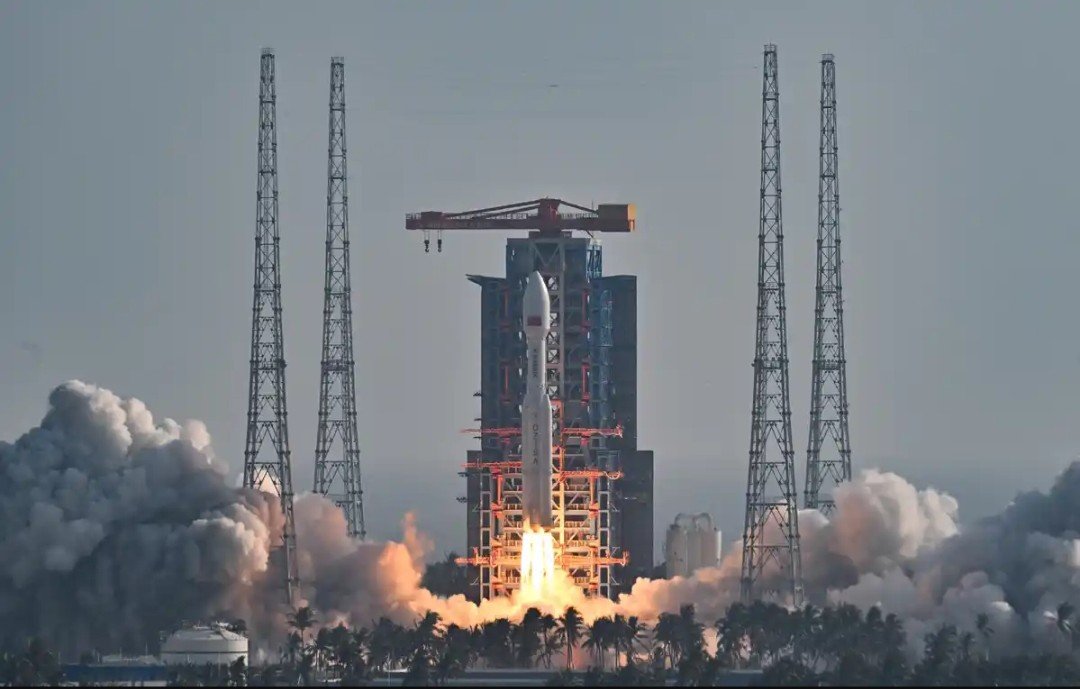
China successfully launched the fourteenth batch of satellites for its new low-Earth orbit (LEO) broadband constellation on Saturday afternoon. This launch continues the country’s steady development of a space-based communication system that serves both international goals and important domestic needs. It demonstrates China’s ongoing progress in a field mainly led by private Western firms, positioning it as a key state actor in the emerging arena of space internet connectivity.
The mission involved satellites designed and built by the China Academy of Space Technology, a major state-owned research institute. These satellites launched from the Hainan International Commercial Aerospace Launch Center. A Long March 8A rocket, developed by the China Academy of Launch Vehicle Technology, lifted off at 3:53 pm local time and successfully placed its payload in the right orbital slots. This rocket model, which is 50.5 meters tall and weighs 371 metric tons at liftoff, achieved a significant milestone by using coal-based rocket kerosene as its main fuel for the first time in this series. This change highlights ongoing national efforts to diversify energy sources and boost technological independence in aerospace engineering.
This launch is just one part of a much larger national program. So far, about 100 satellites for this constellation have been launched this year, contributing to the gradual assembly of a system that, when completed, will have around 13,000 satellites. The scale of this project underscores China’s serious commitment to building a global space infrastructure. Once finished, the network aims to provide high-speed, low-latency internet access worldwide, focusing especially on underserved areas.
The backdrop for this advancement is a quickly changing international scene marked by both competition and cooperation. The satellite internet market has exploded, largely due to private companies like SpaceX’s Starlink and OneWeb. China’s entry introduces a unique, state-managed approach to a market that has mostly been guided by commercial interests. Analysts point out that this sets up a dynamic of technological and strategic competition, as control over next-generation communication infrastructure is crucial for national security, economic strength and digital control. The capacity to deliver global internet coverage from space has significant implications for international development, disaster response and the geopolitical power that comes from setting technical standards and controlling data pathways.
At the same time, the ambitious space-based internet initiative is closely linked to important domestic policy goals. The project aims to bridge the digital divide across China’s vast territory. By ensuring reliable, high-speed internet to remote rural areas, mountains and maritime regions, the constellation supports broader economic and social aims. It has the potential to encourage inclusive digital growth, improve access to education and health care through telemedicine and online learning and enhance logistics and farming practices. This infrastructure is seen as a public benefit, a tool for national development that complements existing ground networks.
China’s extensive space activity provides the foundation for such specialized projects. The recent launch marked the country’s 80th space launch this year and the 612th mission overall for the Long March rocket series. It was also the fifth flight of the Long March 8A variant for these internet satellites. This continuous launch pace shows a strong and growing ability to access space, a crucial resource for carrying out long-term, complex orbital projects.
Observers note that progress in this constellation reflects a national agreement on the strategic importance of space for scientific, economic and social growth. The program, managed by state-owned enterprises and research institutes, channels national resources into what is viewed as a vital utility for the future. The technological skills and industrial capability developed through this effort are expected to benefit the high-tech sector as a whole.
As the constellation expands, it will surely raise further discussions about orbital crowding, space traffic management and the long-term health of the space environment. These challenges are ones that all operators of large satellite constellations, regardless of their country, need to tackle together. China’s involvement ensures it will play an important role in shaping the rules and practices that govern this increasingly crowded orbital space.
The launch on Saturday, though a routine event in China’s busy space schedule, was another solid step in its long-term goals to establish a key role in the international space economy and build infrastructure to meet domestic needs. The ongoing growth of the satellite network reflects national ambitions to use space technology for both strategic balance and public good.