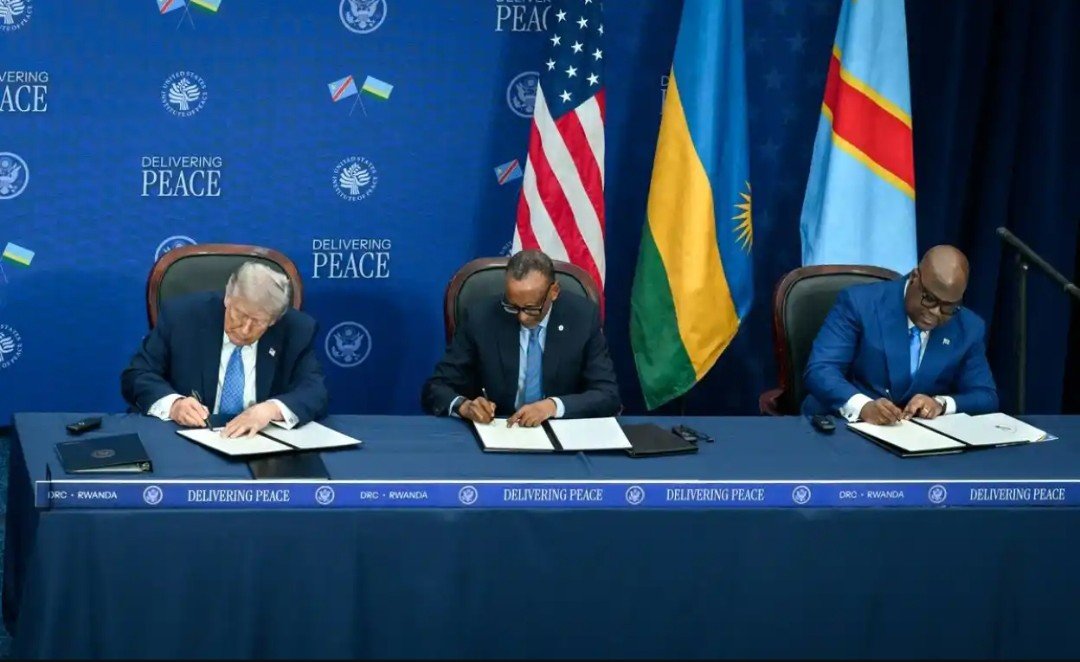
In a solemn ceremony at the White House, the leaders of two nations with a long history of hostility signed a peace agreement. Rwandan President Paul Kagame and Democratic Republic of Congo’s President Félix Tshisekedi endorsed a deal, hosted by U.S. President Donald Trump. The accord aims to stop a cross-border conflict that has caused decades of instability and claimed millions of lives in Central Africa. The signing was accompanied by a Regional Economic Integration Framework (REIF), signed by their foreign ministers, which promotes economic ties and integration.
Trump called it a “great day for Africa and the world” while discussing the complex regional war in straightforward terms. He said, “They spent a lot of time killing each other,” adding, “And now they’re going to spend a lot of time hugging, holding hands, and taking advantage of the United States of America economically like every other country does.” He connected the diplomatic signing to U.S. access to strategic minerals, stating, “I actually stopped the war with Congo and Rwanda and they said please please we would love you to come and take our minerals – which we’ll do. We’re going to take out some of the rare earth. Everybody’s going to make a lot of money.”
This blunt statement highlights a recurring criticism of international involvement in the Congo that political and economic interests often overshadow genuine efforts for peace. Despite the ceremony’s display, it offered only a slight hope against the deep shadows of DR Congo’s ongoing conflict. The accord specifically targets the Rwanda-backed M23 rebel group, demanding that it withdraw from occupied territories in eastern DRC. However, the main causes of violence such as the illegal trade in minerals, entrenched ethnic militias and the struggle over resources and power largely went unaddressed. The truce emerged not from solving these underlying issues but from intense external mediation, casting doubt on its durability from the start.
The conflict’s history is marked by blood and resources. The current situation, involving the M23, is a revival of a rebellion that was initially quashed in 2013. The group’s resurgence in late 2021 has been well-documented by United Nations experts and human rights organizations, which report significant recruitment, training and logistical support from Rwanda. Rwanda denies these claims, but evidence suggests a proxy conflict where regional power struggles and control over mineral-rich eastern Congolese territories are central. The M23 has captured key towns and trading routes, committing widespread atrocities and displacing over one million people, according to humanitarian agencies.
Given this immense human suffering, the economic aspect of the Washington agreement deserves scrutiny. The REIF document emphasizes creating laws, regulations and infrastructure to support raw material extraction and transport. A key focus is the Lobito Corridor, a U.S., EU and African Development Bank-backed project designed to link the copper and cobalt mines of the DRC and Zambia to Angolan ports. Critics argue that while it’s framed as a development initiative, its main purpose is to secure and streamline the export of vital minerals for the global energy transition, especially cobalt for electric vehicle batteries and coltan for electronics.
This focus aligns with U.S. strategic goals of reducing reliance on Chinese-controlled mineral supply chains. For a population where about 70 million citizens live on less than $2.15 a day, the promise of economic corridors often leads to land loss, environmental harm and dangerous working conditions in artisanal mines, with most profits going to foreign corporations and a small political elite.
Congolese Foreign Minister Therese Kayikwamba defended the government’s decision to sign, describing the Washington accord as part of a series of diplomatic milestones. “Do the Congolese people stand behind it? I believe so, because this is our pathway to long-lasting peace,” Kayikwamba said. She recognized the agreement’s shortcomings, stating, “Does this mean that all of the expectations are reflected in the instruments as they exist? Probably not.”
For civil society leaders and observers familiar with the region’s painful history, the official optimism in Washington feels hollow. Maurice Carney, executive director of the advocacy group Friends of the Congo, noted that ratifying such an accord would likely have little practical impact. “If the past five months are any indication, we do not expect anything to fundamentally change in the near future,” Carney said, arguing that commercial interests rather than peace drive the deal. “The economic interests of local elites in Kigali and Kinshasa and global elites in Washington… they converge and those are the interests being met, not those of the Congolese people at all.”
He highlighted the beneficiaries of access to lithium and coltan mines in eastern DRC, pointing out that one significant coltan site is currently under M23 control, showing the connection between militia activity, resource theft and global markets. Carney emphasized that the process is fundamentally unequal. “It’s certainly not an agreement between equal partners,” he noted.
The dynamics of the signing ceremony itself seemed to highlight deep-seated tensions. While Trump spoke of reconciliation, Kagame and Tshisekedi did not shake hands and barely made eye contact. For observers in the region, this body language sent a strong message. “The presidents of both countries did not shake hands. That is very bad for the signing of the peace deal,” remarked Rwandan citizen Marie-Louise Uwizeyimana. “As a citizen living in this region, it shows that there is no peace yet.”
President Kagame offered a cautious, almost pessimistic view, stating there would be “ups and downs on the road ahead.” President Tshisekedi called the agreement merely the start of a new and challenging path. Their subdued tones contrasted sharply with Trump’s enthusiastic claims of profit.
The somber atmosphere in Washington revealed the significant gap between diplomatic language and on-the-ground reality. Lasting peace requires more than demanding militia withdrawal. It needs a complete dismantling of the war economy, accountability for human rights violations and a political and economic framework that prioritizes the well-being of Congolese communities over the efficient extraction of their resources. Unless those conditions are met, agreements signed in distant capitals risk becoming just another chapter in a long history of exploitation, delivering a temporary truce but not a fair or sustainable peace. The ceremony ended, but the structural forces driving the conflict continued their relentless operation.